
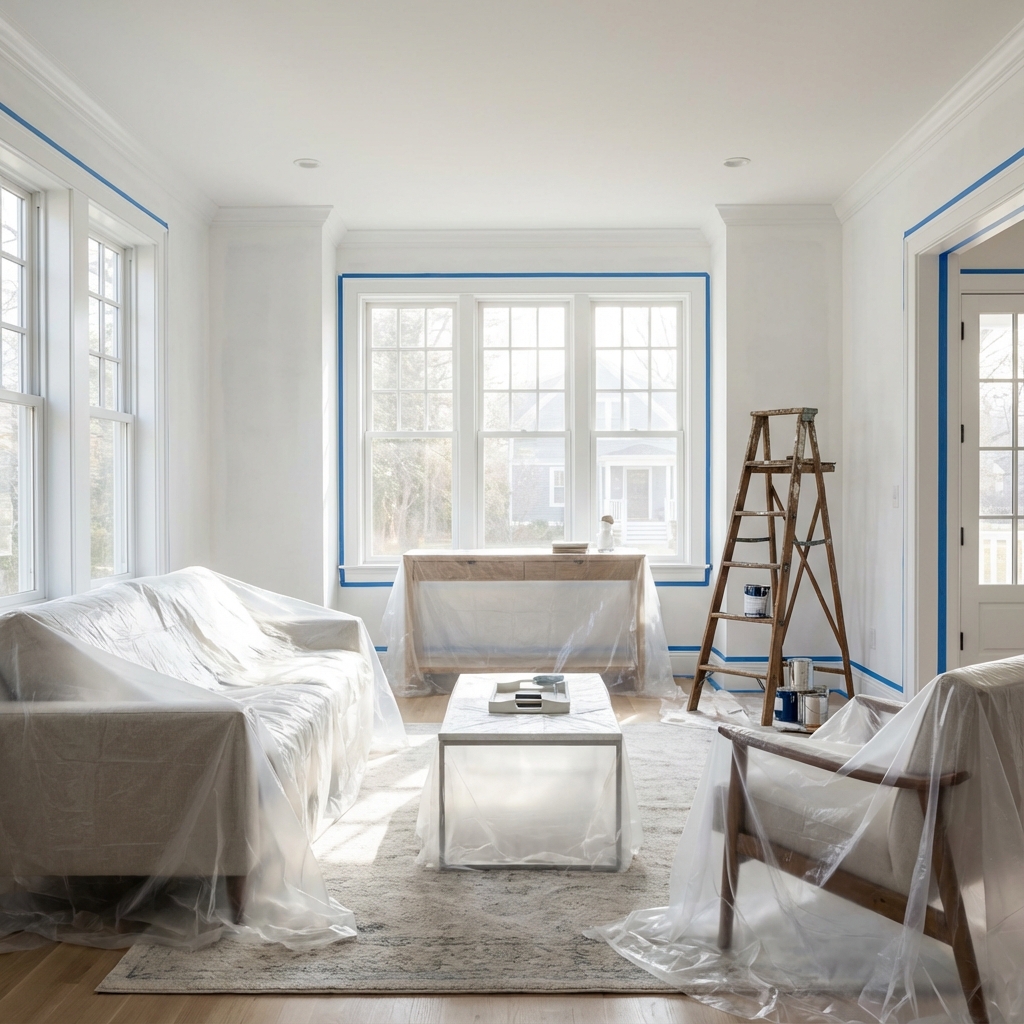
How to Prepare Your Home’s Interior for Professional Painting
You hired professional painting contractors because you want a fresh start without the headache. You’re envisioning the final reveal—the perfect color, the crisp lines—but right now, you’re probably staring at your living room wondering, “How much of this stuff do I actually have to move?”
Here’s the honest truth that most contracts bury in fine print: the success of this endeavor isn’t just determined by the skill of the tradespeople involved. It’s actually the unwritten “site readiness” protocols that dictate whether the project flows perfectly or gets plagued by delays.
Think of it this way: The painter is the artist, but you? You are the “site superintendent” for the pre-production phase.
Let’s walk through how to prep your home so you avoid hidden fees, protect your sanity, and get that magazine-worthy finish.
Key Takeaways
- Define “Prep”: Clarify if “prep” means moving furniture (you) or patching holes (them).
- Clear the Room: Empty rooms allow for a better “wet edge” finish; move electronics to avoid static damage.
- Clean Walls: Grease acts as a bond breaker; wash kitchen and bath walls with TSP.
- Remove Hardware: Remove switch plates to prevent unsightly paint ridges and cracking.
- Patience Pays: Allow 24-48 hours for paint to cure before replacing heavy objects.
1. The “Prep” Disconnect (Or, How to Avoid an Argument)
There is often a source of friction between homeowners and contractors regarding where one job ends and the other begins. This usually comes down to vocabulary.
- Your definition of “Prep”: Likely involves moving a sofa, scrubbing a baseboard, or taking down curtains.
- Their definition of “Prep”: Refers strictly to spackling holes, caulking gaps, and sanding drywall.
Professional painters are experts in coating application, not moving services or janitorial work. If the contract doesn’t explicitly state that the crew will move furniture, you must assume this responsibility. In fact, even if they do agree to move it, you are often paying a skilled labor premium for them to do unskilled labor.
The Reality Check: It is critical to dissect your contract to understand exactly what level of preparation is included. If it’s not a line item, it’s on you.
2. Clearing the Deck: Furniture and Stuff
Imagine trying to cook a gourmet meal on a counter covered in mail and car keys. That’s what a cluttered room feels like to a painter. The efficiency of the crew is directly proportional to the emptiness of the room.
- The “Empty Box” Ideal: The absolute best scenario is full evacuation. Emptying the room completely allows painters to move ladders freely and maintain a continuous “wet edge” while rolling, which looks better.
- The “Archipelago” Method: If you can’t move that heavy oak wardrobe, move it to the center of the room. But be warned: you need to leave a minimum clearance of 3 to 4 feet around the pile so painters aren’t leaning dangerously over your furniture.
- The Static Threat: Here is a scary little fact—plastic drop cloths generate static electricity. If a static-charged sheet touches a television screen or computer, it can discharge and damage the internal components. Don’t just cover electronics; unplug them and move them to a completely separate room.
3. Engineering Your Walls (Yes, It’s Chemistry)
This is the part most homeowners skip, but it matters the most. Paint is a chemical coating, and for it to bond, the surface must be engineered to receive it.
- The Grease Factor: You might think your walls are clean, but if you cook, use hairspray, or just live there, there is likely a film of surfactants and oils on the wall. These contaminants act as “bond breakers,” preventing the paint from fusing with the drywall.
- The Wash: Professional painters rarely wash walls unless explicitly contracted to do so. If you don’t clean them, they will paint right over the grease. For kitchens and baths, use a degreaser like TSP (Trisodium Phosphate) and—this is crucial—rinse it thoroughly with clean water.
- The “Nail Out” Signal: Want to communicate clearly without saying a word? If you want a picture to go back in the exact same spot, leave the nail in the wall. If you want the hole fixed, pull the nail out. Pulling the nail is the universal signal for “patch this”.
4. Hardware: The Mark of a Pro
Want to know the difference between a high-end job and a quick flip? It’s the outlet covers.
- Take Them Off: Painting around switch plates is the mark of an amateur. It leaves unsightly ridges that crack when you eventually remove the plate. Unscrew them all.
- Organize: Tape the screw to the back of the specific plate it belongs to so you don’t lose it.
- The “Bridging” Effect: If you paint over a fixture, the paint forms a continuous film that bridges the gap between the device and the wall. Years later, removing that plate will tear the drywall paper because the paint bond is stronger than the paper itself. Removing hardware now “future-proofs” your walls.
5. Living Through It: Safety and Sanity
Painting disrupts the ecosystem of your home. It’s not just about the smell; it’s about managing the biological occupants—humans and pets.
- Pet Safety: Painters constantly enter and exit, meaning doors will be left open. “Door-darter” pets are at high risk. Also, pet dander floating in the air will settle into wet paint, creating a textured “fur coat” on your new walls. Vacuum thoroughly before the crew arrives.
- Ventilation: Even low-VOC paints off-gas chemicals. Ensure windows open easily and have fans ready.
- Don’t Rush the Return: This is where patience pays off. Paint dries to the touch quickly, but it takes days to “cure”. If you push a heavy object against the wall too soon, “blocking” occurs—the object sticks to the paint, and pulling it away later rips the paint off. Wait at least 24-48 hours for latex paint.
The Bottom Line
By treating the “pre-production” phase as a project management discipline rather than just a list of chores, you effectively de-risk the entire project. You aren’t just helping the painters; you’re ensuring the durability of your investment.